
Optical transmission · transmitter
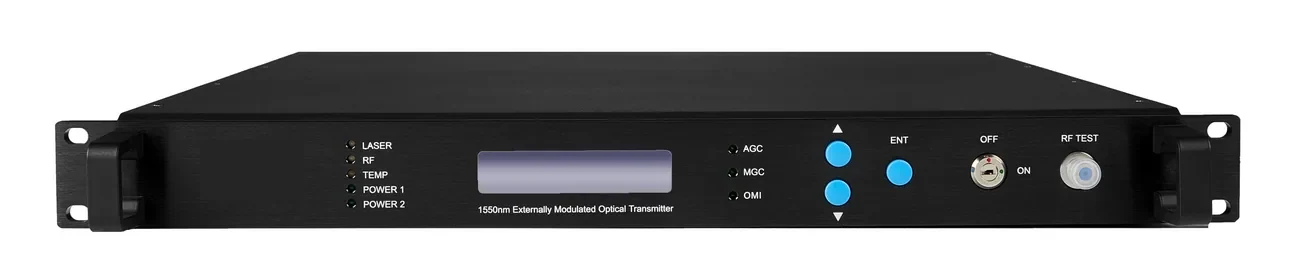
1550 nm Optical Transmitter
1550 nm transmitters for CATV overlay and long-haul transport: direct-modulated 10 dBm and externally modulated 7/9 dBm units, with 47–1000 MHz RF input and optical output for EDFA chains.
Updated October 24, 2026
- Wavelength
- 1550 nm
- Output
- 7 / 9 / 10 dBm
- Modulation
- Direct / external
- RF
- 47–1000 MHz
The short answer
What this product is specified for.
Included in the quotation
- Port count, connector polish and power configuration
- Model-level datasheet and test data
- Optical budget and splitter plan for the ODN
- Export packing, HS code and Incoterm
A 1550 nm transmitter converts an RF CATV signal into an optical signal that can share the PON ODN with data. The 1550 nm window has lower fibre loss than 1310 nm and can be amplified by an EDFA, so one transmitter can feed a passive split and a long chain without regenerating the RF signal.
The choice is direct or external modulation. A direct-modulated 10 dBm unit is the economical choice for a small headend and a short span. An externally modulated 7/9 dBm unit separates the laser from the modulator, reducing chirp and improving tolerance to stimulated Brillouin scattering (SBS) when the launch power or span is high. The RF input covers 47–1000 MHz at 75 Ω; the optical output is SC/APC for the ODN.
At the headend, the transmitter output is combined with the PON wavelengths using a WDM coupler and, where needed, boosted by an EDFA. The receiver at the subscriber end needs +2 to −18 dBm at 1550 nm, so the transmitter power, split ratio, EDFA gain and connector loss must be planned together. A transmitter that is “too strong” can saturate a receiver; one that is too weak will fail at the last split.
Configuration table
The numbers that decide the fit.
Values are from the model datasheet. Where a value is model-dependent, the table says so instead of guessing.
| Type | Output power | Modulation | Typical use |
|---|---|---|---|
| Direct-modulated transmitter | 10 dBm | Direct | Small CATV headend, short span |
| External-modulated transmitter | 7 dBm | External | Long span, high SBS tolerance |
| External-modulated transmitter | 9 dBm | External | Long haul / high split |
Output power, RF input range and connector are model-specific. Confirm the transmitter and EDFA as one chain on the quotation.
Engineering features
What changes on site.
Direct or external
Direct modulation is economical for short spans; external modulation reduces chirp and handles higher launch power.
CATV RF
47–1000 MHz RF input at 75 Ω for analogue and digital CATV channels.
EDFA-ready
The 1550 nm output can feed an EDFA and a passive split for multi-building distribution.
SBS-aware
External modulation is preferred when the launch power or span approaches the SBS threshold.
WDM with PON
Combine with 1310/1490 nm PON using a WDM coupler; the ODN must be rated for all three windows.
Link planning
The transmitter, EDFA, splitter and receiver input range are checked as one optical budget.
Selection guide
Which configuration fits which site.
Start from the site, not from the model. The table is a starting point; the final check is the optical and power budget.
| Scenario | Transmitter | Note |
|---|---|---|
| Small hotel CATV overlay | Direct 10 dBm | Short span, 1:8/1:16 split |
| Campus multi-building | External 7/9 dBm | Check SBS and split loss |
| District / long haul | External 9 dBm | Plan EDFA gain and receiver input |
| FTTH + CATV | Direct or external | WDM coupler at the headend |
Do not exceed the receiver input range; confirm the receiver rating before choosing the transmitter power.
Applications
Where this product is used.
Related equipment
Complete the chain.
The product is quoted as part of a chain. These are the parts that usually travel with it.
Optical transmission · 1550 nm
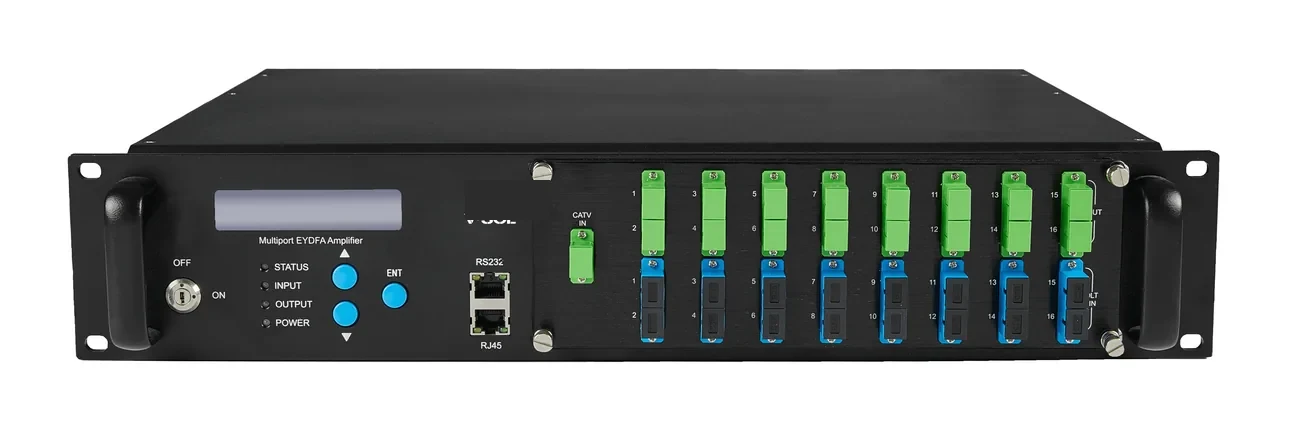
EDFA & 1550 nm Transmitter
CATV overlay and long-haul 1550 nm transport.
1550 nm optical transmitters and erbium-doped fibre amplifiers for CATV overlay and long-distance transport: direct-modulated 10 dBm and external-modulated 7/9 dBm transmitters, plus 4/8/16/32-port EDFA units at 19/22 dBm.
- Wavelength
- 1550 nm
- EDFA ports
- 4 / 8 / 16 / 32
- Output power
- 19 / 22 dBm
- Transmitter
- 7 / 9 / 10 dBm
Best for Campus Fibre Network · FTTH Access Network
View specifications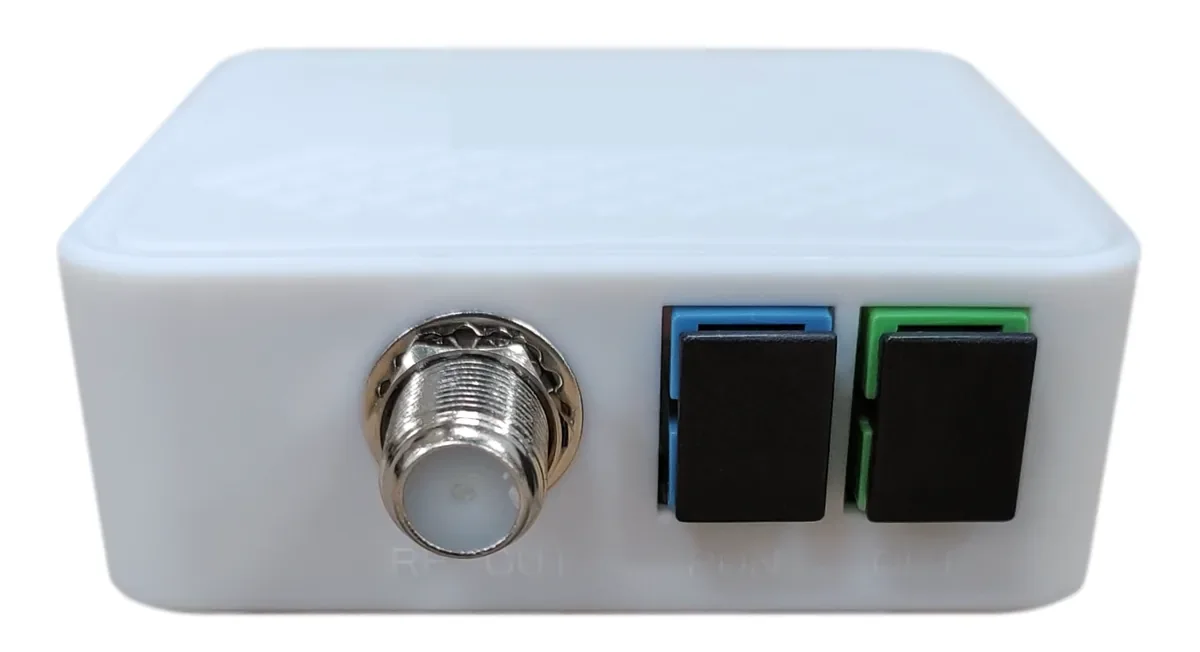
Optical transmission · receiver
CATV Optical Receiver
1550 nm to RF, with AGC options.
CATV optical receivers for FTTH and building distribution: 1550 nm input, 47–1000 MHz RF output, 75 Ω, AGC options and +2 to −18 dBm input range. Models with PON and CATV ports are available for triple-play ONUs.
- Wavelength
- 1550 ± 10 nm
- Input range
- +2 to −18 dBm
- RF band
- 47–1000 MHz
- Impedance
- 75 Ω
Best for FTTH Access Network · Campus Fibre Network
View specifications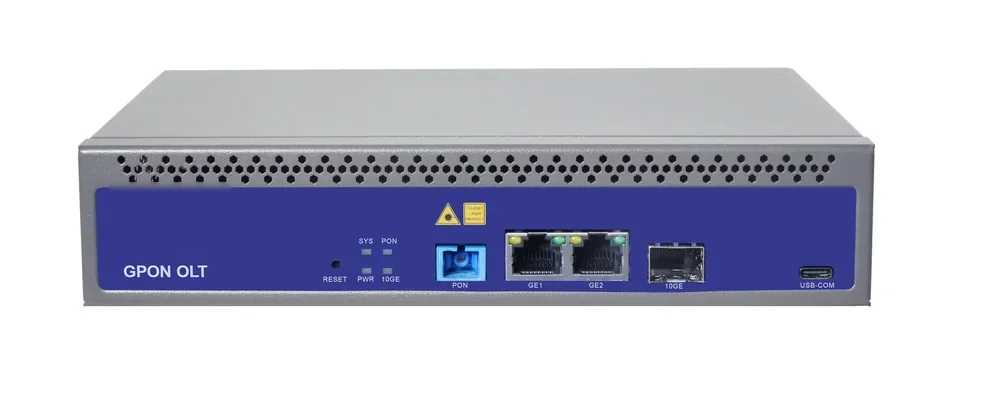
PON access · OLT
GPON OLT
From a 1-PON gateway to a 112-PON headend.
GPON OLT platforms for FTTH, campus and hotel access: 2.5 Gbps downstream and 1.25 Gbps upstream, 1:64 split per PON port and 20 km reach on Class B+ optics. Configurations run from a compact 1-PON gateway with built-in AC to a chassis with up to 112 PON ports.
- Line rate
- 2.5 Gbps ↓ / 1.25 Gbps ↑
- Max split
- 1:64 per PON port
- Reach
- 20 km, Class B+
- PON ports
- 1 – 112
Best for FTTH Access Network · Campus Fibre Network · Outdoor Wireless Coverage
View specifications
PON access · ODN
Fiber Optic Splitter (PLC)
1×2 to 1×64, SC/UPC or SC/APC.
Planar lightwave circuit splitters from 1×2 to 1×64 for PON ODN construction. Typical insertion loss runs from 3.6 dB at 1×2 to 20.5 dB at 1×64; each batch ships with test data and the connector polish you specify.
- Ratios
- 1×2 – 1×64
- Wavelength
- 1260 – 1650 nm
- Insertion loss
- 3.6 – 20.5 dB
- Connector
- SC/UPC / SC/APC
Best for FTTH Access Network · Campus Fibre Network · CCTV & Surveillance Power
View specificationsProduct FAQ
1550 nm Optical Transmitter: questions before the order.
If your question is not here, send the site details and we will answer with the calculation, not a brochure.
Ask an engineerWhat is the difference between direct and external modulation?
Direct modulation modulates the laser current; it is simple and economical but has chirp and SBS limits. External modulation uses a separate modulator, giving lower chirp and better performance over long spans or high launch power.
How many splits can one transmitter feed?
It depends on the output power, the EDFA, the split ratio and the receiver input range. A 10 dBm transmitter with a 1:8 split gives about 1 dBm per output before connector loss; check the receiver +2 to −18 dBm window.
Can I put CATV on the same fibre as GPON?
Yes, with a WDM coupler at the headend and an ONU with a 1550 nm CATV receiver. The ODN splitters and connectors must work across 1310/1490/1550 nm.
What is SBS and why does it matter?
Stimulated Brillouin scattering limits how much optical power can be launched into a fibre before the signal is scattered. External modulation and lower launch power help; the threshold depends on fibre type and span.
Do I need an EDFA with the transmitter?
Only if the split loss and span require more power than the transmitter can deliver. The EDFA and transmitter are selected together against the receiver input range.
Do you supply the WDM coupler and receiver?
Yes. The WDM coupler, CATV receiver, EDFA and transmitter are quoted together so the wavelengths, connector polish and RF level match the headend design.
Next step
Need a 1550 nm Optical Transmitter configuration checked?
Send the endpoint count, the longest run, the power condition and the destination. We reply with the configuration, the optical/power budget and the quotation assumptions.
No obligation. The plan states its assumptions so your engineer can check it.