
PON access · OLT
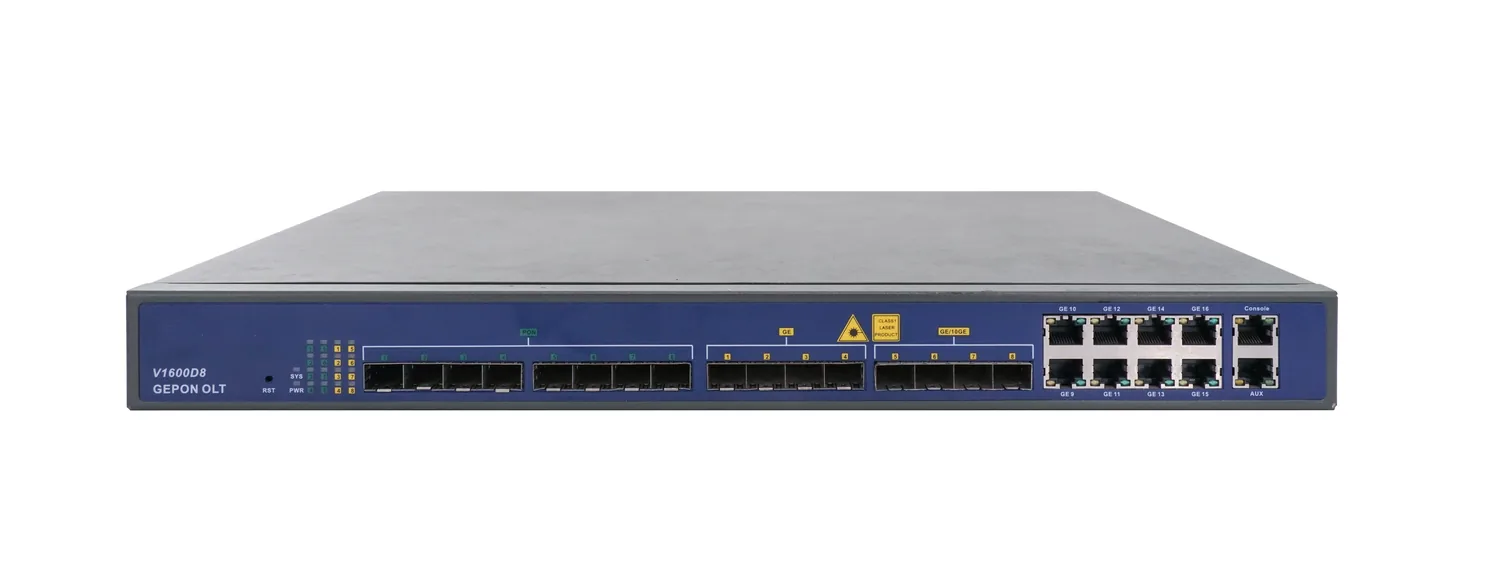
8-Port EPON OLT
A 1U EPON OLT with eight PON ports, 16 uplink ports and a 128 Gbps backplane. It supports 1:64 splitting, 20 km reach and up to 512 ONUs, making it a compact headend for CCTV, campus and small FTTH networks.
Updated October 24, 2026
- PON ports
- 8 × EPON
- Line rate
- 1.25 Gbps symmetric
- Max ONUs
- 512 (64 per port)
- Backplane
- 128 Gbps
The short answer
What this product is specified for.
Included in the quotation
- Port count, connector polish and power configuration
- Model-level datasheet and test data
- Optical budget and splitter plan for the ODN
- Export packing, HS code and Incoterm
This is a 1U, 19-inch EPON OLT built for projects that need a real headend without a chassis. Eight EPON ports run at 1.25 Gbps in both directions, each port supports a 1:64 split and the unit addresses up to 512 ONUs. The uplink side carries eight GE RJ45 ports, four SFP ports and four SFP+ ports, with a 128 Gbps backplane and 89.28 Mpps forwarding rate.
The optical interface is SC/UPC on 9/125 µm single-mode fibre, transmitting at 1310 nm and receiving at 1490 nm. Transmit power is +4.5 to +9 dBm, receiver sensitivity is −32 dBm and the overload point is −8 dBm, with a 20 km reach. Those figures are the ones to put into a link budget before choosing splitter ratios; a 1:64 split consumes about 20.5 dB before connectors and splices are counted.
Layer 2 and Layer 3 features cover the usual project requirements: 4096 VLANs, QinQ, 16K MAC addresses, IGMP snooping for 256 multicast groups, DHCP server/relay/snooping, port isolation, ACL, link aggregation and static routing with RIP/OSPF. Management is available over SNMP, Telnet, CLI, web and SSH, and the unit can run from AC 100–240 V or −48 V DC at 55 W.
Configuration table
The numbers that decide the fit.
Values are from the model datasheet. Where a value is model-dependent, the table says so instead of guessing.
| Parameter | Value |
|---|---|
| Form factor | 1U, 19-inch rack, 442 × 320 × 43 mm, 4.5 kg |
| PON ports | 8 × EPON, SC/UPC, 9/125 µm SMF |
| EPON line rate | 1.25 Gbps upstream / 1.25 Gbps downstream |
| Wavelength | TX 1310 nm / RX 1490 nm |
| Transmit power | +4.5 to +9 dBm |
| Receiver sensitivity / overload | −32 dBm / −8 dBm |
| Max split / reach | 1:64 / 20 km |
| Max ONUs | 512 total, 64 per PON port |
| Uplinks | 8× GE RJ45 + 4× SFP + 4× SFP+ |
| Backplane / forwarding | 128 Gbps / 89.28 Mpps |
| L2 / L3 | 4096 VLAN, QinQ, 16K MAC, IGMP snooping, DHCP snooping, ACL, static route, RIP/OSPF |
| Management | SNMP, Telnet, CLI, WEB, SSH v2 |
| Power | AC 100–240 V, 50/60 Hz; DC −48 V; 55 W |
| Operating temperature | −20 to +60 °C, 5–95% RH non-condensing |
Values are from the model datasheet supplied with the project. Confirm the exact PON optic (PX20++/PX20+++) and power configuration on the quotation.
Engineering features
What changes on site.
Eight ports in one RU
Up to 512 ONUs in a 1U footprint. At 1:64 and 60% fill, eight ports cover roughly 307 active ONUs before the next shelf is needed.
DBA and QoS per LLID
Dynamic bandwidth allocation, per-port rate limiting and multiple LLIDs let CCTV, data and voice share the PON without one service starving another.
Project-grade L2/L3
VLAN isolation, QinQ, IGMP snooping, DHCP snooping, ACL, port mirroring and RSTP/MSTP are available without an extra aggregation switch.
IPv6 ready
IPv6 static and dynamic routing (RIPng, OSPFv3), DHCPv6 and MLD snooping are supported alongside IPv4.
AC or DC feed
AC 100–240 V for premises; −48 V DC for a telecom room or battery plant. Power draw is 55 W.
Field diagnostics
ONU auto-discovery, link detection, remote firmware upgrade, dying-gasp alarm and EMS distance measurement shorten fault finding on a live ODN.
Selection guide
Which configuration fits which site.
Start from the site, not from the model. The table is a starting point; the final check is the optical and power budget.
| Network type | Why EPON fits | Watch-out |
|---|---|---|
| CCTV / security campus | Symmetric 1.25 Gbps is ample for camera upload; ONUs are inexpensive | Camera VLAN and multicast plan must be set before handover |
| Small FTTH / ISP edge | Eight ports cover a village or estate without a chassis | Check uplink: 8×GE may bottleneck if all ports run at line rate |
| Hotel / campus data | One ODN for data, voice and IPTV | Separate VLANs and QoS for IPTV and guest Wi-Fi |
If the existing headend or ONU stock is GPON, use the GPON OLT instead; EPON and GPON ONUs are not interchangeable on the same PON port.
Integration
Where it sits in the chain.
The PON chain starts at the OLT port, passes through the splitter and the ODN, and ends at the ONU. The split ratio and the connector count decide the optical margin.
- One bill of materials for the whole chain
- Connector polish and PON mode confirmed before order
- Model-level test data supplied with the shipment
Related equipment
Complete the chain.
The product is quoted as part of a chain. These are the parts that usually travel with it.
PON access · OLT
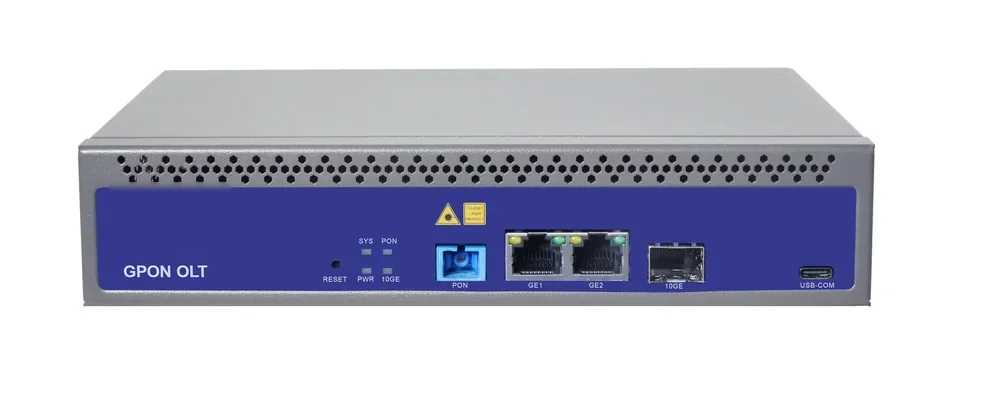
GPON OLT
From a 1-PON gateway to a 112-PON headend.
GPON OLT platforms for FTTH, campus and hotel access: 2.5 Gbps downstream and 1.25 Gbps upstream, 1:64 split per PON port and 20 km reach on Class B+ optics. Configurations run from a compact 1-PON gateway with built-in AC to a chassis with up to 112 PON ports.
- Line rate
- 2.5 Gbps ↓ / 1.25 Gbps ↑
- Max split
- 1:64 per PON port
- Reach
- 20 km, Class B+
- PON ports
- 1 – 112
Best for FTTH Access Network · Campus Fibre Network · Outdoor Wireless Coverage
View specifications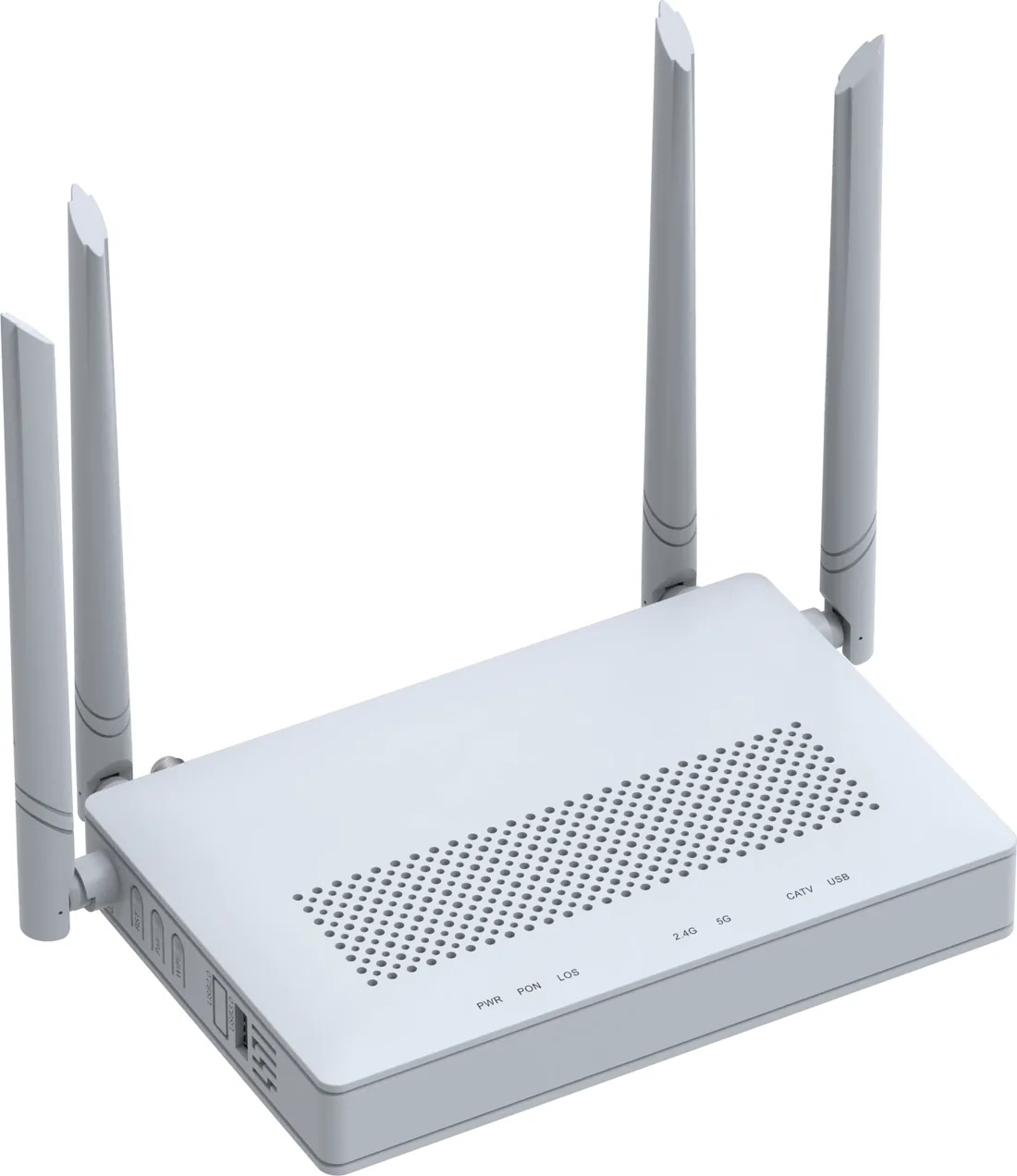
PON access · ONU / ONT
GPON / XPON ONU & ONT
From a 1-GE bridge to a 4-GE Wi-Fi 6 gateway.
XPON ONU and ONT options for FTTH, hotel rooms, offices and outdoor cabinets: 1, 2 or 4 GE ports, Wi-Fi 4/5/6, CATV and POTS options, and 10G PON models. All units are SC single-mode, 20 km, EPON/GPON dual-mode where the model supports it.
- PON
- XPON, EPON/GPON
- User ports
- 1 – 4 × GE
- Wi-Fi
- Wi-Fi 4 / 5 / 6
- Reach
- 20 km
Best for FTTH Access Network · Campus Fibre Network · Outdoor Wireless Coverage
View specifications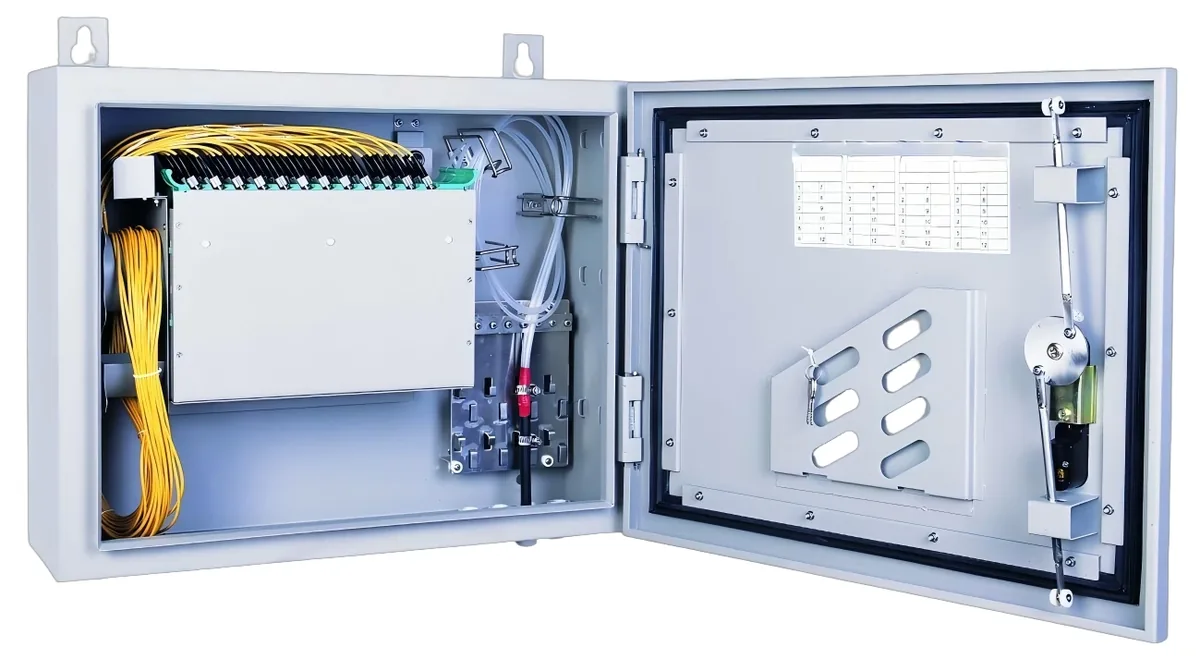
PON access · ODN
Fiber Optic Splitter (PLC)
1×2 to 1×64, SC/UPC or SC/APC.
Planar lightwave circuit splitters from 1×2 to 1×64 for PON ODN construction. Typical insertion loss runs from 3.6 dB at 1×2 to 20.5 dB at 1×64; each batch ships with test data and the connector polish you specify.
- Ratios
- 1×2 – 1×64
- Wavelength
- 1260 – 1650 nm
- Insertion loss
- 3.6 – 20.5 dB
- Connector
- SC/UPC / SC/APC
Best for FTTH Access Network · Campus Fibre Network · CCTV & Surveillance Power
View specifications
PON access · PoE ONU
PoE ONU & Reverse PoE
Power the ONU from the LAN, or the LAN from the ONU.
PoE ONU variants for corridors, rooms and MDUs: reverse-PoE (PD) units powered by a PoE switch, PSE units that power cameras and APs, and 4/8/24-port models for floor distribution. One XPON uplink, up to 24 PoE outputs.
- Uplink
- XPON / 10G PON
- PoE ports
- 1 – 24
- Modes
- PSE / PD
- Power
- 802.3af/at
Best for CCTV & Surveillance Power · Campus Fibre Network · Outdoor Wireless Coverage
View specificationsProduct FAQ
8-Port EPON OLT: questions before the order.
If your question is not here, send the site details and we will answer with the calculation, not a brochure.
Ask an engineerDoes this OLT support 1:128 splitting?
The datasheet rating is 1:64 per PON port, with a maximum of 64 ONUs per port and 512 ONUs on the unit. Plan within that rating; a higher ratio reduces optical margin and is not the published configuration.
How far can the PON run?
20 km on the specified optics. The real limit is the optical budget after the splitter, connectors and splices. A 1:64 split leaves little margin at 20 km; a 1:32 or 1:16 split is safer for long rural spans.
Can I mix EPON and GPON ONUs on this OLT?
No. This is an EPON OLT. GPON ONUs need a GPON OLT (or an XPON ONU configured for EPON). Mixing technologies on one PON port will not register.
Is it suitable for IPTV?
Yes, with IGMP snooping and 256 multicast groups. Put IPTV on its own VLAN and reserve bandwidth in the DBA profile; do not rely on best-effort for live channels.
What uplink should I use?
Eight GE RJ45 ports are enough for a 4–6 Gbps aggregate; use the SFP+ ports for 10G trunking to the core. Do not oversubscribe the uplink more than 4:1 if all PON ports carry paid services.
What is included with the OLT?
The unit, rack ears, power cable and the model datasheet. PON SFP optics, uplink SFP modules, ODF and splitters are quoted separately so the connector and reach match the ODN.
Next step
Need a 8-Port EPON OLT configuration checked?
Send the endpoint count, the longest run, the power condition and the destination. We reply with the configuration, the optical/power budget and the quotation assumptions.
No obligation. The plan states its assumptions so your engineer can check it.