
Application · wireless
Outdoor Wireless Coverage
Outdoor and corridor Wi-Fi APs need a data link, a power source and a mounting point. PoF combines the first two over one hybrid cable to 200 m, which is often the difference between a clean ceiling install and a new mains spur.
Updated October 24, 2026
- Copper limit
- 100 m
- PoF limit
- 200 m
- PoF power
- 12 W / port
- PON reach
- 20 km
The engineering problem
Why the obvious answer fails.
The endpoint is small; the distance, the power and the environment are not. Three paragraphs explain where the design usually breaks.
An outdoor AP is usually mounted where the network is not: a pole, a roof edge, a far corridor, a car park. The data cable can reach it, but the power socket cannot. Running a mains spur to each AP adds an electrician, a conduit, a weatherproof box and a surge path; on a large site it can cost more than the AP.
Distance is the second issue. A PoE run is limited to 100 m; a car park or a long corridor easily exceeds it. A PoE extender solves the distance but still needs power at the mid-point, which is often the same problem moved 100 m away.
PoF removes both constraints in one cable: one fibre for data and one copper pair for 48 V DC, up to 200 m and 12 W per port. For a Wi-Fi 6 AP drawing 10–15 W, that is enough; for a high-power outdoor AP with a heater, it is not, and the design should use a local switch or a higher-power cabinet.
Path comparison
Four paths, one decision.
The correct path is the one that matches the endpoint power, the distance and the presence of mains. Do not compare only on cable price.
| Path | Reach | Power at the endpoint | Mains at endpoint | Best for | Limits |
|---|---|---|---|---|---|
| Copper PoE | 100 m channel | 15.4 / 30 W at the source (af / at) | Required for the switch | Devices within 100 m of a powered cabinet | Cable loss, surge path, no reach beyond 100 m |
| PoE extender | 200 – 500 m with hops | Reduced at each hop | Required at every extender | Retrofit where a mid-point has power | Another powered box outdoors; still copper |
| Power over Fiber | Up to 200 m per port | Up to 12 W per port | Not required | Ceiling APs, pole cameras, readers, sensors | 12 W per port, hybrid cable, 200 m limit |
| Fibre + local PoE switch | 20 km PON backhaul | Local switch budget | Required at the local cabinet | Cabinets, buildings, dense clusters | Needs a powered cabinet and a switch |
The correct path is the one that matches the endpoint power, the distance and the presence of mains. Do not compare only on cable price.
Design approach
How we lay it out.
Map the AP load and the mounting points
Record the AP model, PoE class, nominal and peak draw, mounting height and distance to the nearest cabinet. A Wi-Fi 6 AP is usually 10–15 W; an outdoor AP with a heater can be 25 W or more.
Check the 200 m and 12 W envelope
If the run is under 200 m and the load under 12 W, a PoF splitter plus a PoF ONU/AP is the cleanest path. Keep 20% headroom for cable loss and radio peak.
Use the ceiling ONU as the AP
The PoF ceiling ONU is a Wi-Fi 6 AX3000 access point with a PON uplink. It is managed by the gateway/OLT and supports zero-touch provisioning and roaming, so no local controller is needed.
Bill of materials
A starting BOM.
Quantities follow the endpoint count and the number of cabinets. Adjust after the site survey.
| Item | Specification | Quantity basis |
|---|---|---|
| Optical gateway / OLT | 1× GPON + 2× GE + 1× 10GE SFP+ | 1 per building or floor group |
| PoF power splitter | 1×9, 8 outputs, 120 W supply | 1 per 8 APs |
| Hybrid PoF cable | G.657A2 + copper, 20/50 m | 1 per AP + 10% spare |
| PoF ceiling ONU / AP | Wi-Fi 6 AX3000, 1× GE | 1 per coverage cell |
| Mounting kit | Ceiling or pole bracket | 1 per AP |
| SPD | At the building entry / cabinet | Per local code |
For a 16-AP floor, use two splitters and one cascade link; check the PON optical budget before cascading.
Numbers to check
The design rules.
| Design rule | Value to confirm |
|---|---|
| PoF reach | 200 m per port |
| PoF power | 12 W per port |
| Wi-Fi 6 AP load | 10 – 15 W typical; check peak |
| APs per splitter | 8 (16 with cascade) |
| PoE limit | 100 m copper |
| Splitter budget | 8 × 12 W = 96 W; do not exceed the 120 W supply |
Recommended equipment
What this design usually uses.
Power over Fiber · access
PoF Switch & PoF ONU
One hybrid cable to the ceiling: data and 12 W.
A Power-over-Fiber access set: an optical gateway, an 8-output PoF power splitter, hybrid PoF cable and a ceiling Wi-Fi 6 ONU. Each output delivers up to 12 W to 200 m, so ceiling APs and cameras run without a local mains socket.
- Power per port
- Up to 12 W
- Reach
- Up to 200 m
- Outputs
- 8 + 1 cascade
- Wi-Fi
- Wi-Fi 6 AX3000
Best for Outdoor Wireless Coverage · Campus Fibre Network · Parking Lot Camera System
View specificationsPower over Fiber · splitter
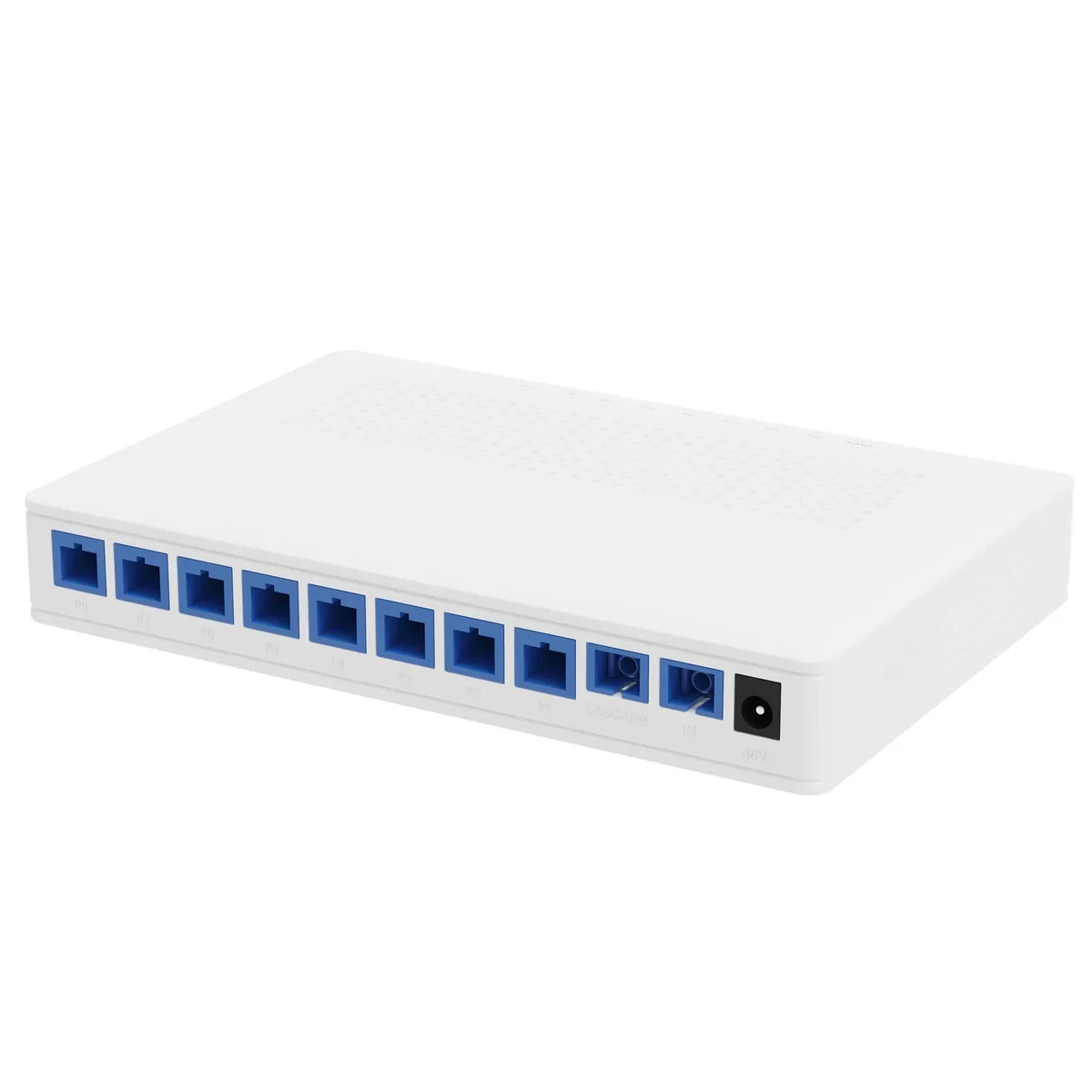
PoF Power Splitter
Eight outputs, 12 W each, one cascade port.
A 1×9 PoF power splitter that combines an optical splitter and a 48 V DC power distributor in one box. It feeds eight PoF ONUs at up to 12 W each to 200 m and provides a cascade port for a second splitter.
- Split
- 1×9 (8 + cascade)
- Output power
- ≤12 W per port
- Supply
- 48 V DC, 120 W
- Insertion loss
- ≤16.5 dB output
Best for Outdoor Wireless Coverage · Parking Lot Camera System · Bollard & Access Control Power
View specifications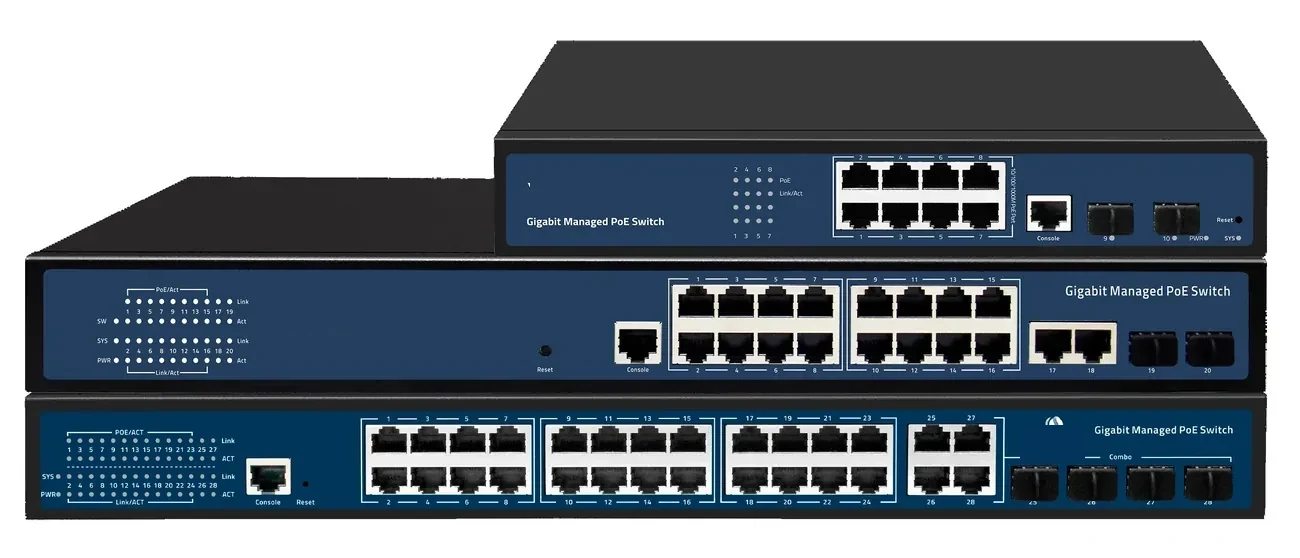
PoE switching · managed & unmanaged
PoE Switches
8 to 48 PoE ports, with 10G and 100G uplinks.
PoE switch families from compact 4–8 port units to 48-port Layer 3 switches with 100G uplinks. IEEE 802.3af/at power, VLAN and IGMP isolation, and a 100 m copper limit that decides where the fibre has to take over.
- Ports
- 4 – 48 × GE PoE
- Uplinks
- GE / 10G / 100G
- Power
- 802.3af / at
- Distance
- 100 m copper
Best for CCTV & Surveillance Power · Parking Lot Camera System · Perimeter Security Power
View specifications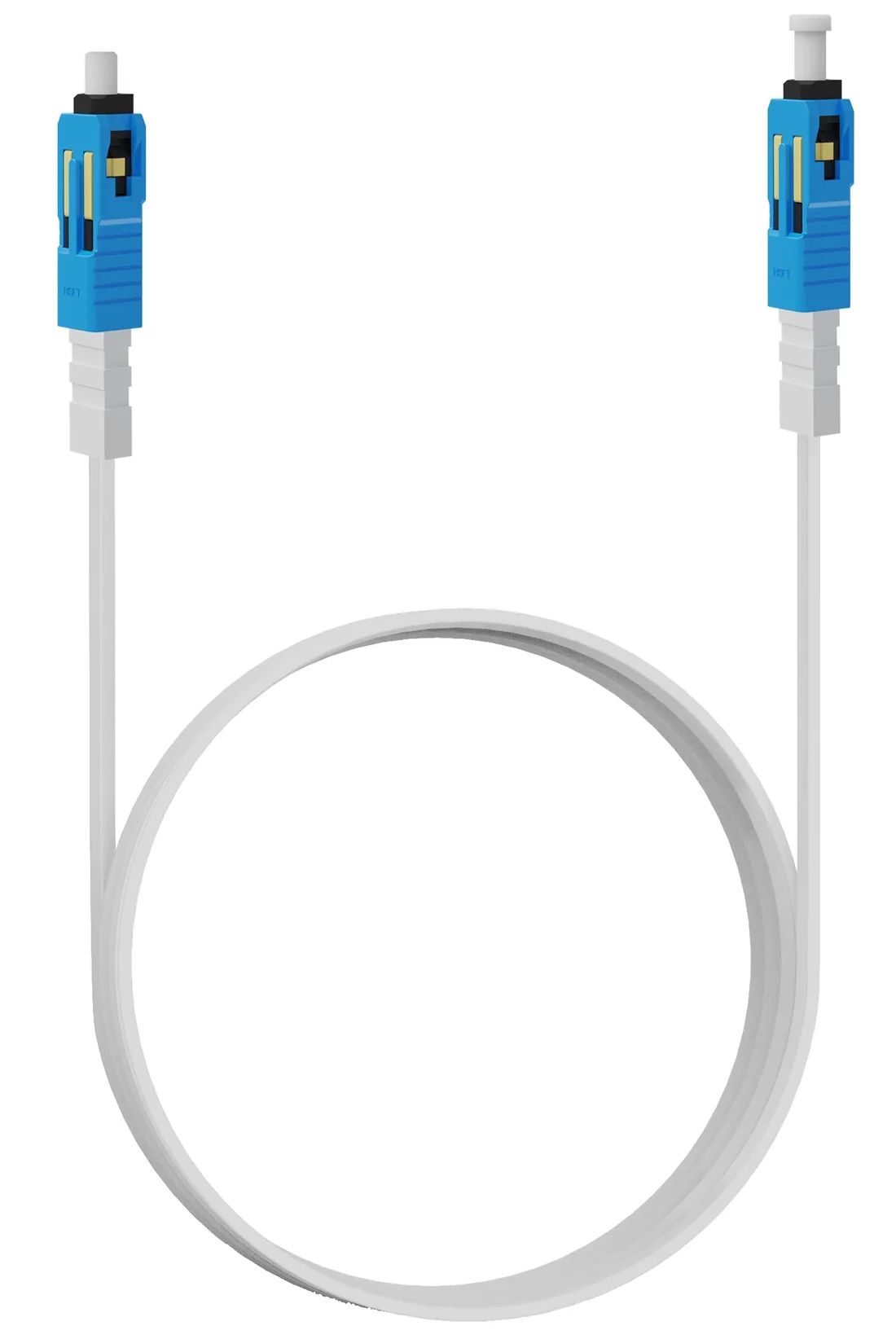
Power over Fiber · cable
Hybrid PoF Cable
G.657A2 fibre and copper in one flat jacket.
A flat hybrid cable with one G.657A2 fibre and a copper pair, terminated SC/UPC and supplied in 3, 20 or 50 m lengths. Attenuation is ≤0.4 dB/km at 1310 nm and ≤0.3 dB/km at 1550 nm; the jacket is rated −20 to +80 °C.
- Fibre
- G.657A2, single core
- Attenuation
- ≤0.4 / ≤0.3 dB/km
- Lengths
- 3 / 20 / 50 m
- Temperature
- −20 to +80 °C
Best for Outdoor Wireless Coverage · Parking Lot Camera System · Bollard & Access Control Power
View specificationsApplication FAQ
Outdoor Wireless Coverage: site questions.
If your question is not here, send the site details and we will answer with the calculation, not a brochure.
Ask an engineerCan PoF power a Wi-Fi 6 AP?
Yes if the AP draws under 12 W including peak radio load. The PoF ceiling ONU is itself a Wi-Fi 6 AX3000 AP, so the ONU and the AP are one device in that design.
How far can an outdoor AP be from the building?
Up to 200 m on PoF for a 12 W load. Beyond that, run fibre to a local cabinet with a PoE switch and power the AP locally, or use a point-to-point wireless backhaul.
Do I need a controller for roaming?
The PoF ceiling APs are managed by the gateway’s built-in AC or the OLT, with seamless roaming. If you use third-party APs, roaming depends on their controller or standard 802.11k/v/r support.
What about lightning?
The fibre is dielectric, so it does not bring a metallic path to the AP. The 48 V pair still needs surge protection at the building entry and a bonded mounting pole; follow local code.
Can I use PoF for a high-power outdoor AP?
Only if its peak draw stays under 12 W. Outdoor APs with heaters often exceed that; use a local PoE switch in a cabinet or a higher-power PoF design.
How many APs per PoF splitter?
Eight, or 16 with a second splitter on the cascade port. Keep the total DC load within the 120 W supply and check the optical budget after the cascade.
Next step
Planning Outdoor Wireless Coverage?
Send the device list, the longest run, the mains condition and the country. We return the path, the BOM and the budget assumptions.
No obligation. The plan states its assumptions so your engineer can check it.