
Switching · aggregation
10G / 100G Aggregation Switches
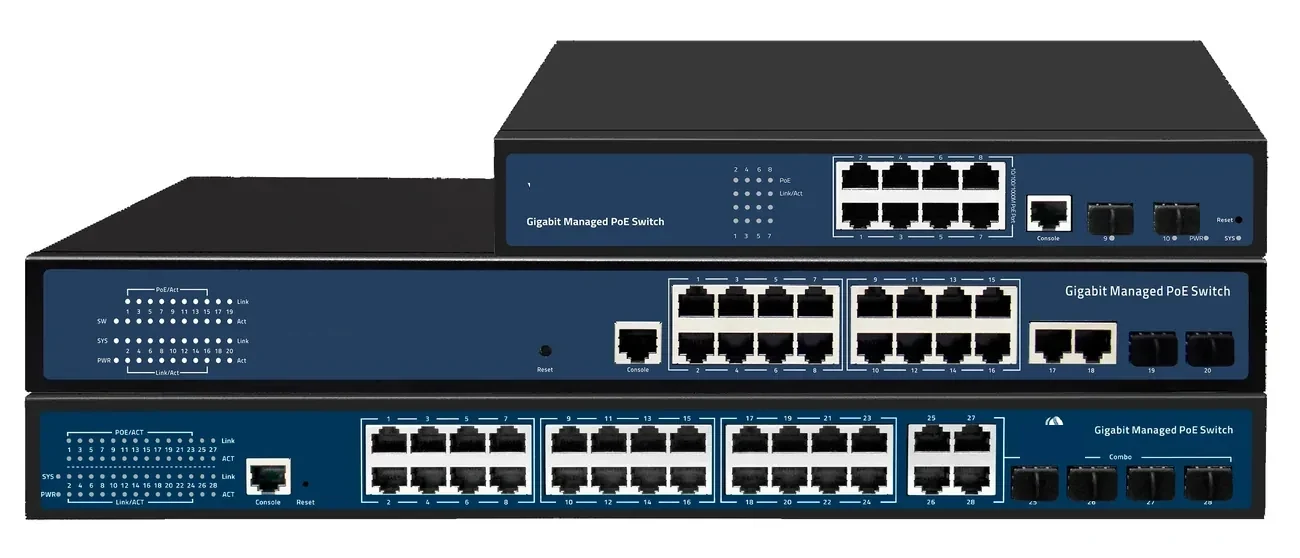
Layer 3 aggregation switches for campus cores and data-centre edge: 12–24 × 10GE SFP+ ports, 100GE QSFP28 uplinks, and 24/48-port GE models with 10G uplinks. The port mix and routing feature set are confirmed per model.
Updated October 24, 2026
- 10G ports
- 12 – 24 × SFP+
- 100G uplinks
- 2× QSFP28
- Management
- L3
- Form factor
- 1U
The short answer
What this product is specified for.
Included in the quotation
- Port count, connector polish and power configuration
- Model-level datasheet and test data
- Optical budget and splitter plan for the ODN
- Export packing, HS code and Incoterm
An aggregation switch sits between the access switches and the core. It concentrates 10G links from buildings, floors or servers and hands them to the core over 100GE. The difference from an access switch is the port mix and the routing: more SFP+ ports, fewer copper ports, and L3 features for inter-VLAN routing and dynamic routing.
The family covers a 12×10GE SFP+ switch for a small campus core, a 24×10GE SFP+ switch with two 100GE QSFP28 uplinks for a larger core, and 24/48-port GE switches with 4–6×10GE uplinks for building aggregation. The port mix, switching capacity and routing feature set are model-specific; the quotation states the exact configuration.
Design the aggregation layer around the uplink, not the port count. A 24×10GE switch with a single 100GE uplink can oversubscribe if every port runs at line rate; a 2×100GE pair gives headroom and redundancy. For a campus, the aggregation switch also becomes the boundary between the building VLANs and the core routing domain.
Configuration table
The numbers that decide the fit.
Values are from the model datasheet. Where a value is model-dependent, the table says so instead of guessing.
| Family | Access ports | Uplinks | Management | Typical use |
|---|---|---|---|---|
| 12×10GE aggregation | 12× 10GE SFP+ | — | L3 | Small campus core |
| 24×10GE / 100G | 24× 10GE SFP+ | 2× 100GE QSFP28 | L3 | Large campus / DC edge |
| 24GE + 10G uplink | 24× GE | 4× 10GE SFP+ | L3 | Building aggregation |
| 48GE + 10G uplink | 48× GE | 4–6× 10GE SFP+ | L3 | Dense building aggregation |
| 20GE SFP + combo | 20× GE SFP + 4× combo | 4× 10GE SFP+ | L3 | Fibre aggregation |
Switching capacity, routing protocols and stacking support are model-specific. Confirm the exact feature set on the datasheet.
Engineering features
What changes on site.
10G / 100G
SFP+ access ports and QSFP28 uplinks concentrate building or server links without a copper bottleneck.
L3 routing
Static routing, RIP and OSPF for inter-VLAN routing at the aggregation layer; confirm the model routing feature set.
VLAN and QoS
VLAN, QinQ, ACL, QoS and IGMP snooping keep CCTV, guest and tenant traffic separated.
Redundancy
STP/RSTP/MSTP and link aggregation support a redundant uplink or ring between buildings.
One management path
SNMP, CLI, web and SSH; the same VLAN plan can be pushed from the core to the access switches.
Uplink headroom
Size the uplink for the busy-hour load, not the port count. A 2×100GE pair gives headroom and redundancy.
Selection guide
Which configuration fits which site.
Start from the site, not from the model. The table is a starting point; the final check is the optical and power budget.
| Site | Recommended | Why |
|---|---|---|
| Small campus core | 12×10GE SFP+ | Concentrates a few building uplinks |
| Large campus core | 24×10GE + 2×100GE | Headroom and redundant 100G uplinks |
| Building aggregation | 24/48GE + 4–6×10GE | Copper access with 10G uplink |
| Fibre aggregation | 20GE SFP + 4×10GE | Many fibre drops, fewer copper ports |
Confirm whether the model supports the routing protocol and redundancy scheme the core design requires.
Related equipment
Complete the chain.
The product is quoted as part of a chain. These are the parts that usually travel with it.
PoE switching · managed & unmanaged
PoE Switches
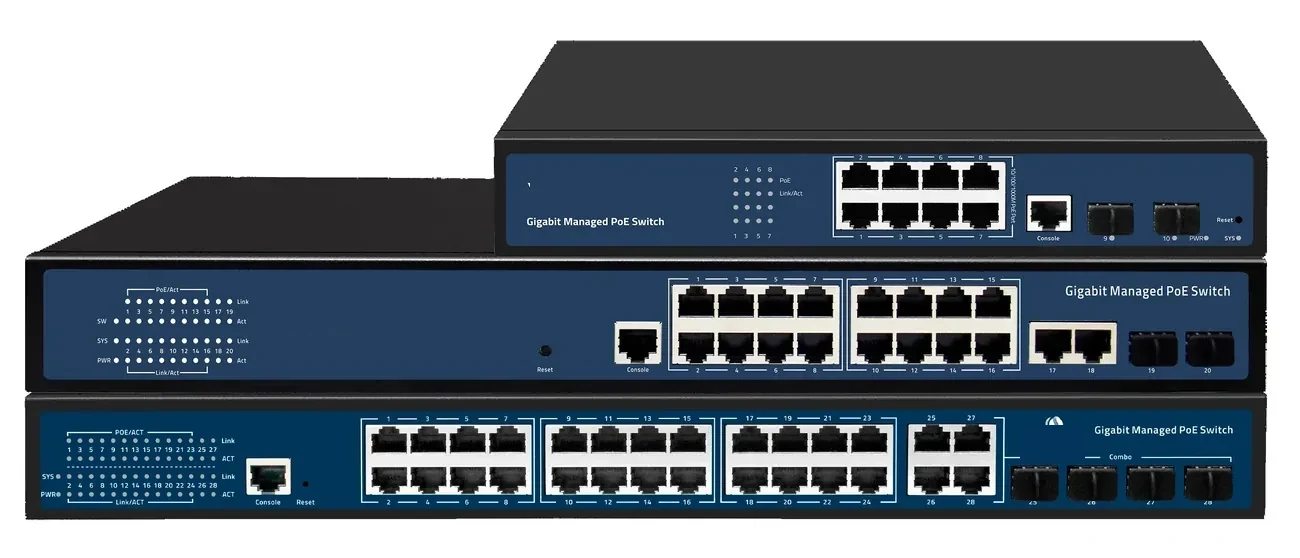
8 to 48 PoE ports, with 10G and 100G uplinks.
PoE switch families from compact 4–8 port units to 48-port Layer 3 switches with 100G uplinks. IEEE 802.3af/at power, VLAN and IGMP isolation, and a 100 m copper limit that decides where the fibre has to take over.
- Ports
- 4 – 48 × GE PoE
- Uplinks
- GE / 10G / 100G
- Power
- 802.3af / at
- Distance
- 100 m copper
Best for CCTV & Surveillance Power · Parking Lot Camera System · Perimeter Security Power
View specifications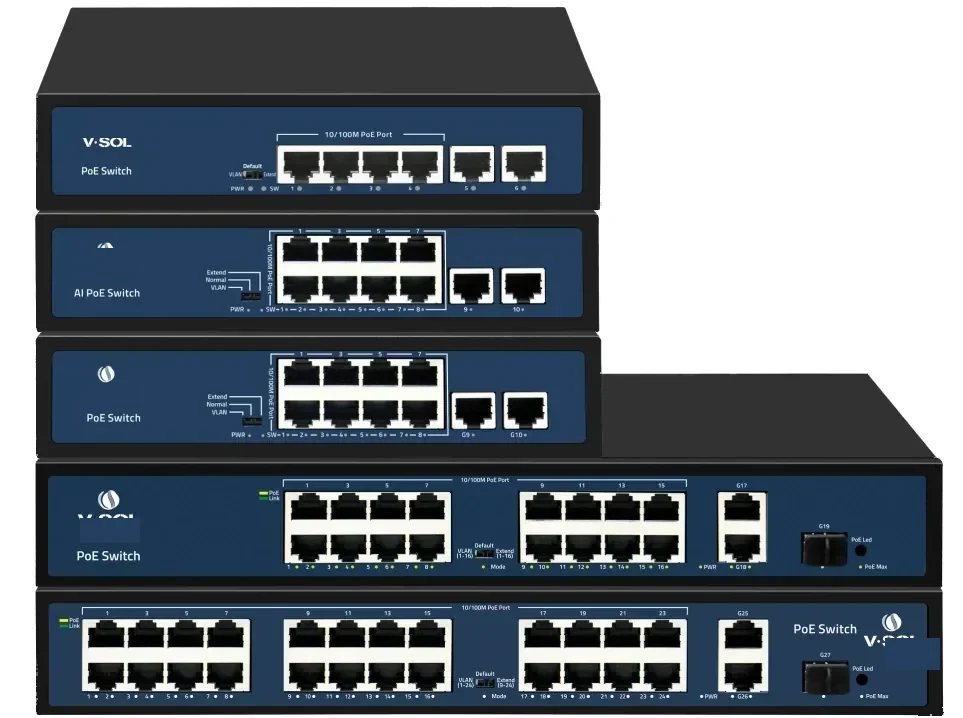
PoE switching · 24 port
24-Port PoE Switch
24 PoE ports and four 10G uplinks in 1U.
A 1U Layer 2/Layer 3 PoE switch with 24 GE PoE access ports and four 10GE/GE SFP+ uplinks. It is the standard choice for a CCTV floor, a wireless floor or a building distribution cabinet.
- Access ports
- 24 × GE PoE
- Uplinks
- 4 × 10GE SFP+
- Management
- L2 / L3
- Form factor
- 1U rack
Best for CCTV & Surveillance Power · Campus Fibre Network · Outdoor Wireless Coverage
View specifications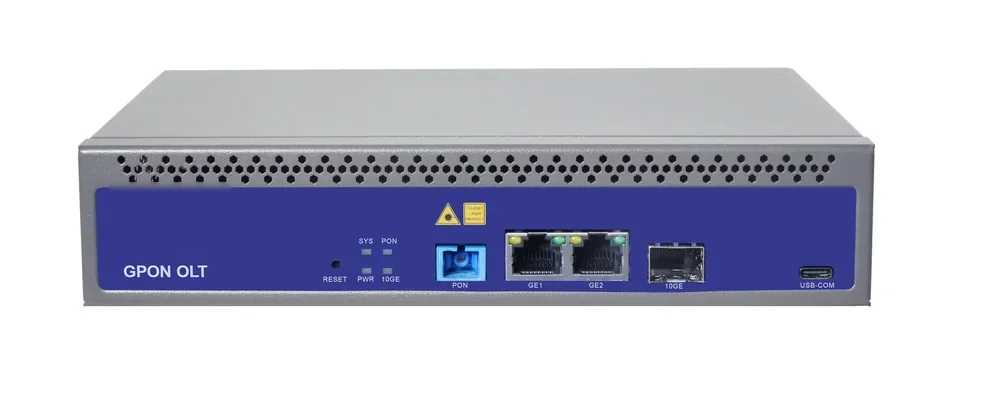
PON access · OLT
GPON OLT
From a 1-PON gateway to a 112-PON headend.
GPON OLT platforms for FTTH, campus and hotel access: 2.5 Gbps downstream and 1.25 Gbps upstream, 1:64 split per PON port and 20 km reach on Class B+ optics. Configurations run from a compact 1-PON gateway with built-in AC to a chassis with up to 112 PON ports.
- Line rate
- 2.5 Gbps ↓ / 1.25 Gbps ↑
- Max split
- 1:64 per PON port
- Reach
- 20 km, Class B+
- PON ports
- 1 – 112
Best for FTTH Access Network · Campus Fibre Network · Outdoor Wireless Coverage
View specifications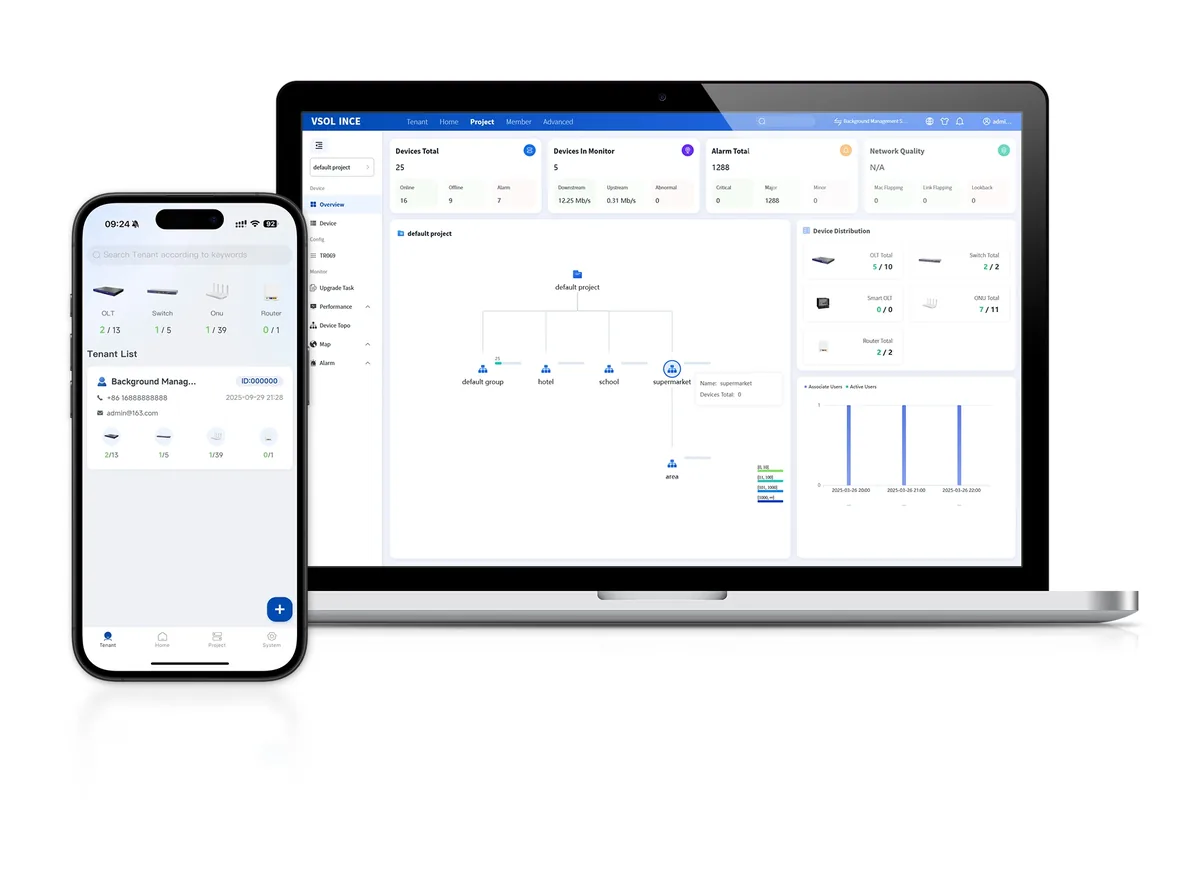
Software · management
Network Management & Cloud Platform
One view of OLT, ONU, AP and PoE.
Management options for PON and PoE networks: OLT-based OMCI/OAM, SNMP/CLI, TR-069 ACS and a cloud platform for topology, provisioning, alarms and remote maintenance across multiple sites.
- PON management
- OMCI / OAM
- Switching
- SNMP / CLI
- CPE
- TR-069 ACS
- Cloud
- Topology / alarms
Best for FTTH Access Network · Campus Fibre Network · Industrial & Tunnel Network
View specificationsProduct FAQ
10G / 100G Aggregation Switches: questions before the order.
If your question is not here, send the site details and we will answer with the calculation, not a brochure.
Ask an engineerDo I need an aggregation switch or a PoE switch?
Use an aggregation switch when the job is to concentrate 10G/100G links and route between VLANs. Use a PoE switch when the job is to power cameras or APs. A campus usually needs both.
How many 100G uplinks?
Two QSFP28 uplinks give a 200 Gbps aggregate or a redundant 2×100G LAG. One uplink is a single point of failure for 24×10GE ports.
Does it support OSPF?
The L3 models support static routing, RIP and OSPF; the exact feature set is model-specific. Confirm the routing protocol on the datasheet.
Can I use it for CCTV?
Yes for the aggregation layer, but the cameras still need PoE switches at the edge. The aggregation switch concentrates the building uplinks and separates the CCTV VLAN.
Is stacking supported?
Stacking support is model-specific. If the design needs a stack, confirm the model and the stacking cables before the order.
What about 25G/40G?
The family covers 10G SFP+ and 100G QSFP28. For 25G/40G, confirm the available model and optics on the quotation.
Next step
Need a 10G / 100G Aggregation Switches configuration checked?
Send the endpoint count, the longest run, the power condition and the destination. We reply with the configuration, the optical/power budget and the quotation assumptions.
No obligation. The plan states its assumptions so your engineer can check it.