
PoE switching · 24 port
24-Port PoE Switch
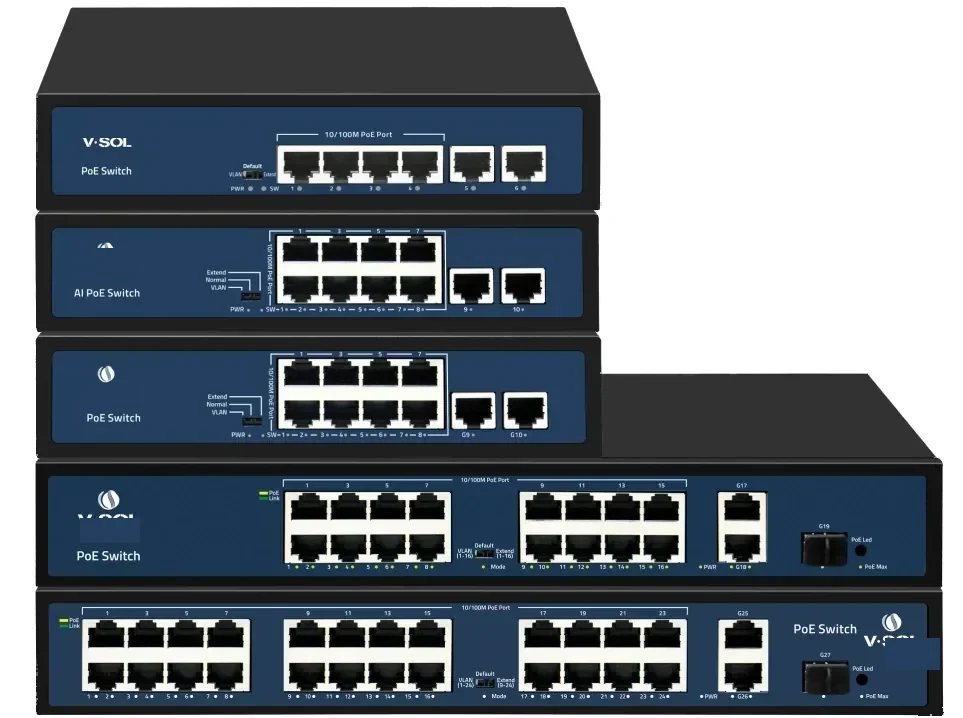
A 1U Layer 2/Layer 3 PoE switch with 24 GE PoE access ports and four 10GE/GE SFP+ uplinks. It is the standard choice for a CCTV floor, a wireless floor or a building distribution cabinet.
Updated October 24, 2026
- Access ports
- 24 × GE PoE
- Uplinks
- 4 × 10GE SFP+
- Management
- L2 / L3
- Form factor
- 1U rack
The short answer
What this product is specified for.
Included in the quotation
- Port count, connector polish and power configuration
- Model-level datasheet and test data
- Optical budget and splitter plan for the ODN
- Export packing, HS code and Incoterm
The 24-port PoE switch is the workhorse of a building network. It puts 24 powered access ports and four 10G SFP+ uplinks in one rack unit, which is enough for a floor of cameras, a floor of APs, or a mix of cameras, APs and access control. The 10G uplink matters when a recorder or the core is on the other side of the building: a single GE uplink would be the bottleneck for 24 busy ports.
The power budget is the first decision. Twenty-four fixed cameras at 8 W need about 192 W before cable loss; twenty-four 802.3at devices at 30 W would need 720 W, which is beyond most 24-port budgets. In practice a 24-port switch is specified with a 370–500 W budget and a mixed load, or split across two switches when every port is a PTZ or a high-power AP. Ask for the budget curve, not just the port count.
Layer 2 and Layer 3 features cover VLAN, QinQ, STP/RSTP/MSTP, link aggregation, IGMP snooping, DHCP snooping, ACL, QoS, port mirroring and static routing/RIP/OSPF on the L3 variants. Management is over SNMP, CLI, web and SSH. For a CCTV VLAN, enable IGMP snooping and set the recorder port as the multicast router port; otherwise every camera stream floods every access port.
Configuration table
The numbers that decide the fit.
Values are from the model datasheet. Where a value is model-dependent, the table says so instead of guessing.
| Parameter | Value |
|---|---|
| Access ports | 24 × GE RJ45, PoE |
| Uplinks | 4 × 10GE/GE SFP+ |
| PoE standard | IEEE 802.3af / 802.3at |
| PoE budget | Model-specific; confirm the budget and powered-port count |
| Switching capacity | Model-specific; confirm on datasheet |
| VLAN | 4096 VLANs, QinQ, port isolation |
| Multicast | IGMP snooping, querier |
| Redundancy | STP / RSTP / MSTP, link aggregation |
| Management | SNMP, CLI, web, SSH |
| Form factor | 1U, 19-inch rack |
The 24-port family includes L2 and L3 variants. Confirm the routing feature set if you need inter-VLAN routing at the switch.
Engineering features
What changes on site.
One rack unit, 24 ports
24 access ports and four 10G uplinks in 1U. A 42U rack can hold 20+ switches and still leave room for servers and patch panels.
10G uplink, not GE
Four SFP+ uplinks support a 40 Gbps aggregate or a redundant 2 × 10G LAG, so the uplink is not the bottleneck for 24 cameras.
CCTV-grade multicast
IGMP snooping and querier support keep 24 camera streams on the recorder port instead of flooding every access port.
Per-port PoE control
Enable, disable or schedule PoE per port; reboot a frozen camera from the management UI without a site visit.
Ring and LAG
RSTP/MSTP and link aggregation support a ring between cabinets or a dual-homed uplink to the core.
Clear labelling
Label the port-to-device map on both the switch and the patch panel. A 24-port fault is usually a cable, not a configuration.
Selection guide
Which configuration fits which site.
Start from the site, not from the model. The table is a starting point; the final check is the optical and power budget.
| Load | Budget to specify | Note |
|---|---|---|
| 24 fixed cameras at 8 W | ≥250 W | Add 20% headroom and cable loss |
| 16 cameras + 8 APs | ≥300 W | Mixed classes; check AP peak |
| 24 PTZ cameras at 25 W | ≥720 W | Usually needs two switches or a higher-budget model |
| 24 APs at 15 W | ≥450 W | Wi-Fi 6 APs can peak above their nominal class |
Do not spec a 24-port switch by port count alone. The budget, the uplink and the management level are the three real choices.
Related equipment
Complete the chain.
The product is quoted as part of a chain. These are the parts that usually travel with it.
PoE switching · managed & unmanaged
PoE Switches
8 to 48 PoE ports, with 10G and 100G uplinks.
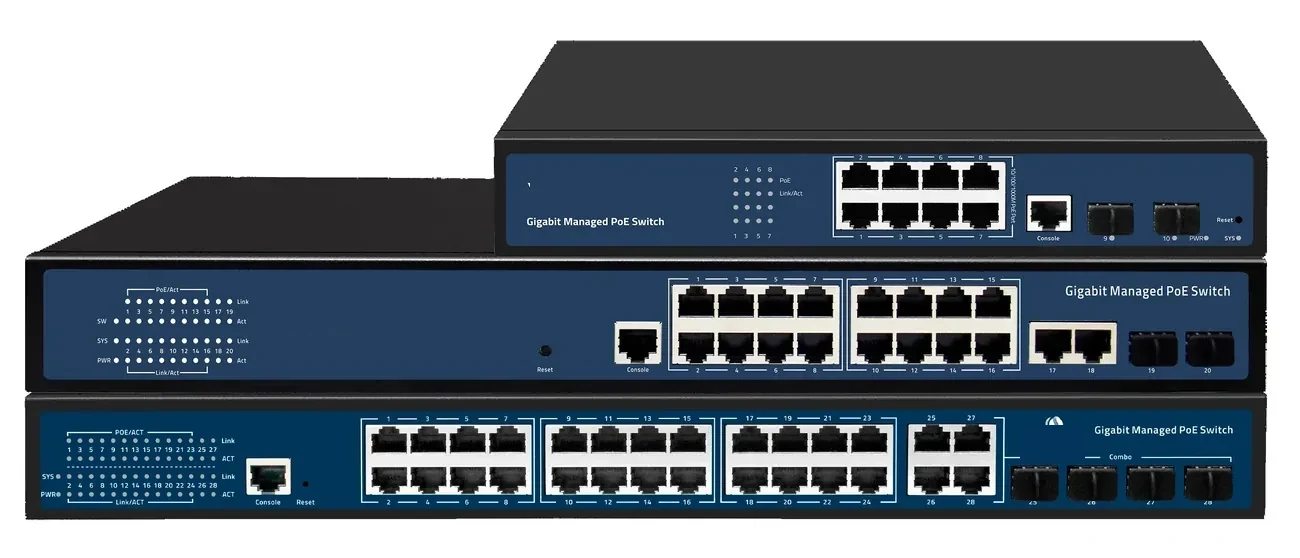
PoE switch families from compact 4–8 port units to 48-port Layer 3 switches with 100G uplinks. IEEE 802.3af/at power, VLAN and IGMP isolation, and a 100 m copper limit that decides where the fibre has to take over.
- Ports
- 4 – 48 × GE PoE
- Uplinks
- GE / 10G / 100G
- Power
- 802.3af / at
- Distance
- 100 m copper
Best for CCTV & Surveillance Power · Parking Lot Camera System · Perimeter Security Power
View specifications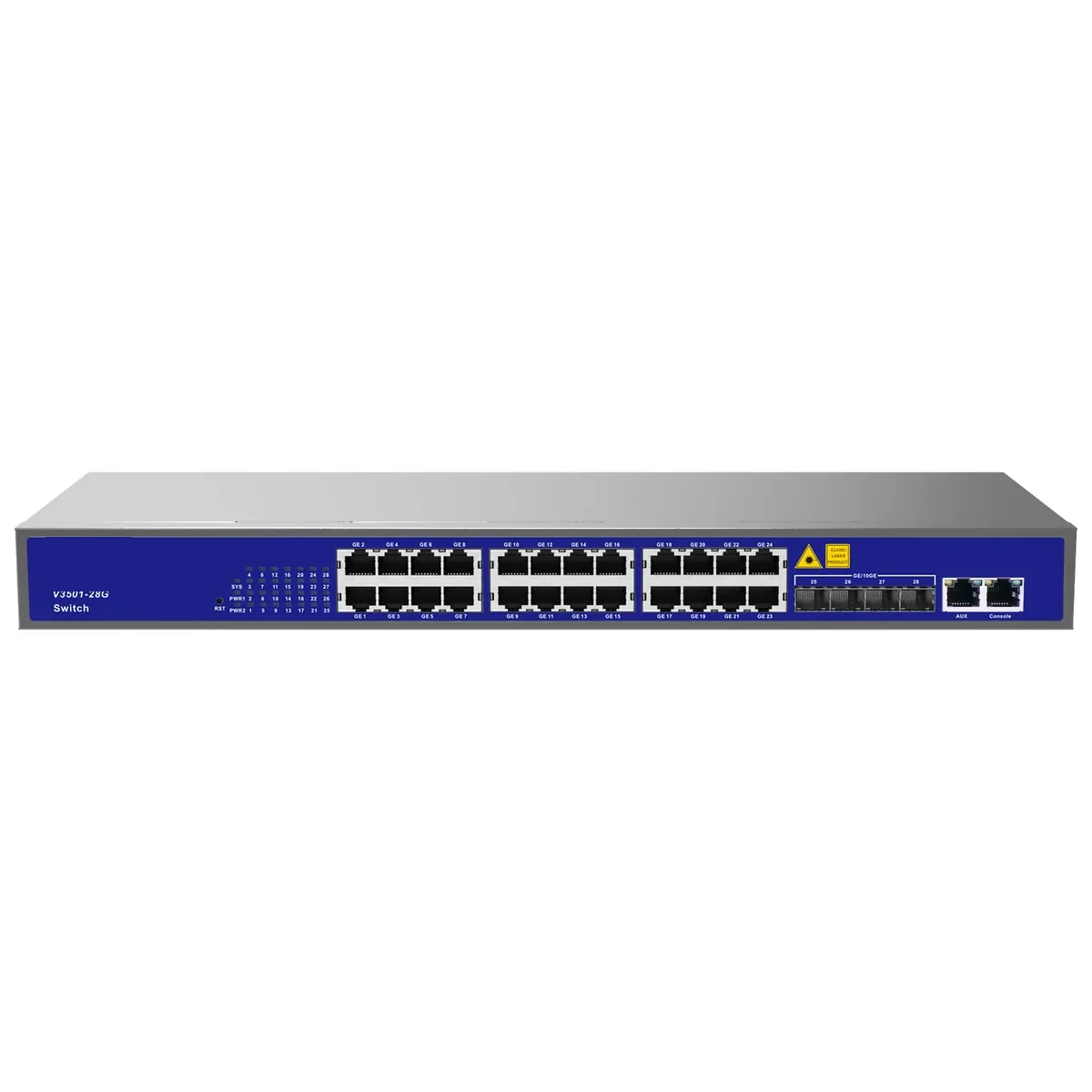
PoE switching · compact
8-Port PoE Switch
Small-count PoE for poles, kiosks and shops.
Compact 4- and 8-port PoE switches for small camera groups, wireless APs and access control. Fanless, desktop or wall mounted, with 802.3af/at power and a GE or SFP uplink.
- Ports
- 4 or 8 × GE PoE
- Power
- 802.3af / at
- Cooling
- Fanless
- Mount
- Desktop / wall
Best for CCTV & Surveillance Power · Parking Lot Camera System · Bollard & Access Control Power
View specifications
PoE switching · hardened
Industrial PoE Switch
Hardened switching for tunnels, roads and plants.
Industrial PoE switching specified per project: DIN-rail mounting, wide-temperature operation, redundant DC input, higher surge immunity and ring recovery for tunnels, highways, plants and perimeter sites.
- Mounting
- DIN rail / wall
- Temperature
- Wide-range model
- Power
- Redundant DC
- Network
- Ring / RSTP
Best for Industrial & Tunnel Network · Perimeter Security Power · Parking Lot Camera System
View specifications
PON access · PoE ONU
PoE ONU & Reverse PoE
Power the ONU from the LAN, or the LAN from the ONU.
PoE ONU variants for corridors, rooms and MDUs: reverse-PoE (PD) units powered by a PoE switch, PSE units that power cameras and APs, and 4/8/24-port models for floor distribution. One XPON uplink, up to 24 PoE outputs.
- Uplink
- XPON / 10G PON
- PoE ports
- 1 – 24
- Modes
- PSE / PD
- Power
- 802.3af/at
Best for CCTV & Surveillance Power · Campus Fibre Network · Outdoor Wireless Coverage
View specificationsProduct FAQ
24-Port PoE Switch: questions before the order.
If your question is not here, send the site details and we will answer with the calculation, not a brochure.
Ask an engineerHow many watts do 24 PoE ports need?
It depends on the devices. 24 × 8 W = 192 W; 24 × 15.4 W = 370 W; 24 × 30 W = 720 W. Add 20% headroom and cable loss, then choose a switch whose budget covers the total.
Do I need Layer 3?
Only if the switch must route between VLANs or act as the gateway for the site. A Layer 2 switch with a router/firewall upstream is enough for most CCTV and wireless networks.
Can I use the 10G ports for copper?
The SFP+ ports accept 10G optics or 1G SFP modules; copper 10G requires a 10GBASE-T SFP+ module, which has a shorter reach and higher power draw. Use fibre for building-to-building runs.
Why do my camera streams flood the network?
IGMP snooping is off or there is no querier. Enable IGMP snooping on the CCTV VLAN and make sure the recorder or router is the querier; otherwise multicast is treated as broadcast.
Is there a redundant power option?
Power-supply configuration is model-specific. If the site needs dual feeds, specify it on the quotation and confirm the model’s input arrangement.
Can this switch power a PoE ONU?
Yes, if the ONU is a reverse-PoE (PD) model. The switch supplies power over the copper; the ONU converts it for its own use. A standard ONU needs a DC adapter.
Next step
Need a 24-Port PoE Switch configuration checked?
Send the endpoint count, the longest run, the power condition and the destination. We reply with the configuration, the optical/power budget and the quotation assumptions.
No obligation. The plan states its assumptions so your engineer can check it.