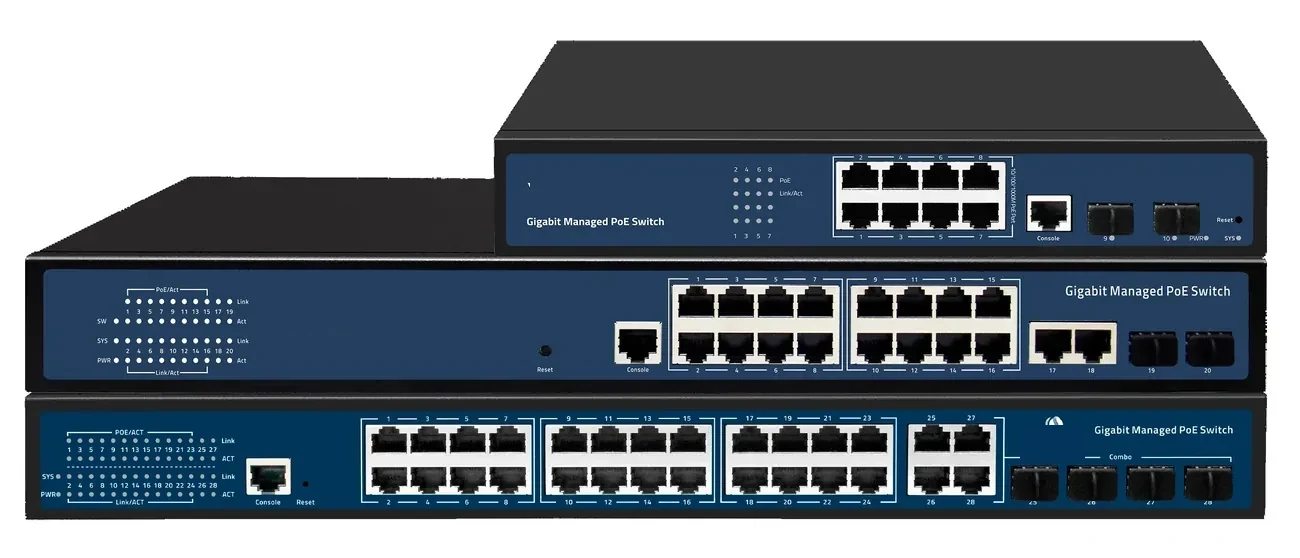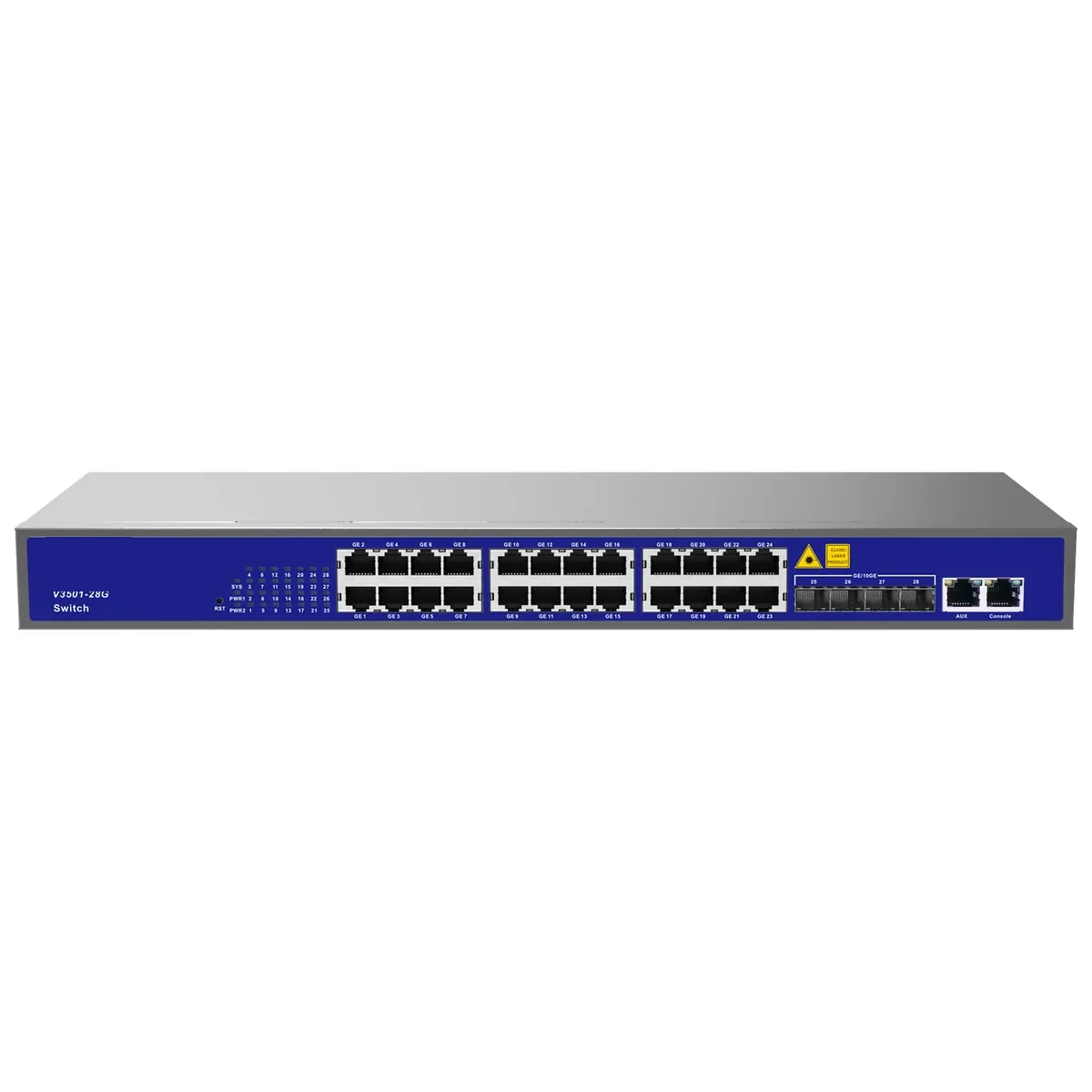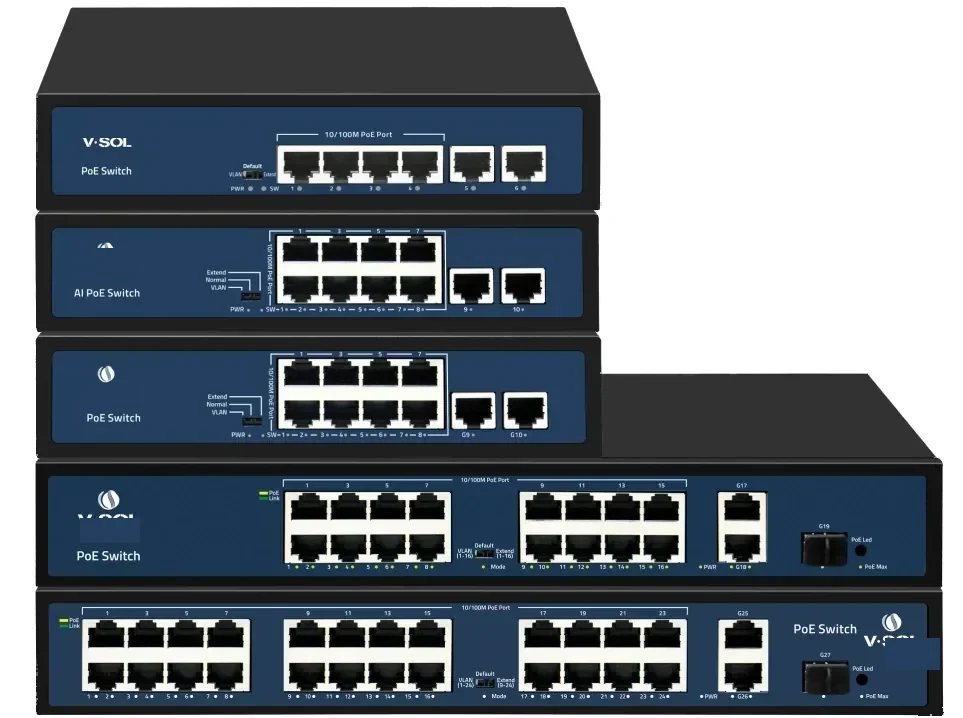
How many ports do you actually need?
Count the devices, then add 20% for spares and growth. A 20-camera site should not be designed on a 24-port switch with four spare ports; one failed port and one added AP consume the margin. A 24-port switch for 18–20 devices is more comfortable.
Do not forget the uplink and the management port. Some switches use one or two access ports for uplinks; others have dedicated SFP/SFP+ ports. Read the port map, not the headline number.
What PoE budget should you specify?
Add the maximum power of every device, add 10–15% for cable loss, add 20% headroom, and compare with the switch budget. If the result is above the budget, reduce the load or choose a higher-budget model. Do not rely on the per-port maximum.
A mixed load is common: 16 cameras at 8 W (128 W), 4 APs at 15 W (60 W), 2 PTZ at 25 W (50 W) = 238 W; +20% = 286 W. A 370 W switch is adequate. A 240 W switch is not.
| Load | Calculation | Minimum budget |
|---|---|---|
| 8 fixed cameras | 8 × 8 W = 64 W | 77 W with 20% headroom |
| 24 fixed cameras | 24 × 8 W = 192 W | 230 W |
| 16 cameras + 8 APs | 128 W + 120 W = 248 W | 298 W |
| 24 PTZ at 25 W | 600 W | 720 W — usually two switches |
GE or 10G uplink?
A single GE uplink carries about 125 MB/s in each direction. Twenty-four cameras at 4 Mbps each use about 96 Mbps, which fits; twenty-four 4K streams at 16 Mbps use 384 Mbps, still inside GE but with little room. If the recorder is central and the switch is at the edge, a 10G SFP+ uplink removes the bottleneck and supports a redundant LAG.
For a small switch with eight cameras, GE is enough. For a 24/48-port switch with a central recorder and a busy uplink, 10G is the safer choice. Fibre SFP+ also removes the copper path between buildings.
Managed or unmanaged?
Managed for VLANs, IGMP snooping, port diagnostics, PoE control and remote reboot. Unmanaged for a small isolated group with no VLAN plan and no remote monitoring. The price difference is small compared with a truck roll.
Layer 3 is only needed if the switch routes between VLANs. For most CCTV and Wi-Fi networks, a Layer 2 switch plus a router/firewall is enough.
What else changes the model?
Form factor, fan noise, operating temperature, redundant power and mounting. A fanless 8-port unit is right for a small cabinet; a 48-port switch with fans belongs in a rack, not a sealed box. An outdoor cabinet needs a hardened model and an IP-rated enclosure.
Check the power input: AC, 48 V DC, or dual feed. A site with a battery plant or a solar supply may need a DC input, not an AC adapter.
- Port count + 20% spare.
- Total PoE budget + 20% headroom.
- GE vs 10G uplink from the recorder/AP load.
- Managed for VLAN, IGMP, diagnostics.
- Fanless / rack / hardened for the enclosure.
- AC or DC input, redundant feed if critical.
| Enclosure | Form factor | Cooling | Watch-out |
|---|---|---|---|
| Indoor rack | 24/48-port rack | Fans; front-to-back airflow | Rack depth and blanking panels |
| Small wall cabinet | 8/16-port fanless | Passive | Ambient temperature and clearance |
| Outdoor cabinet | Hardened extended-temperature | Passive or fan | IP rating, condensation, surge |
| Wall / desk | Compact fanless | Passive | Cable bend radius and physical security |
| Industrial panel | DIN rail, 48 V DC | Passive | Vibration, wide temperature, SPD |
A sealed box does not make an office switch outdoor-rated. Match the switch to the enclosure, not the other way round.
Use this on a real site
Send the endpoint count, the longest run, the mains condition and the load. We will apply this calculation to your project and return the optical/power budget with the bill of materials.